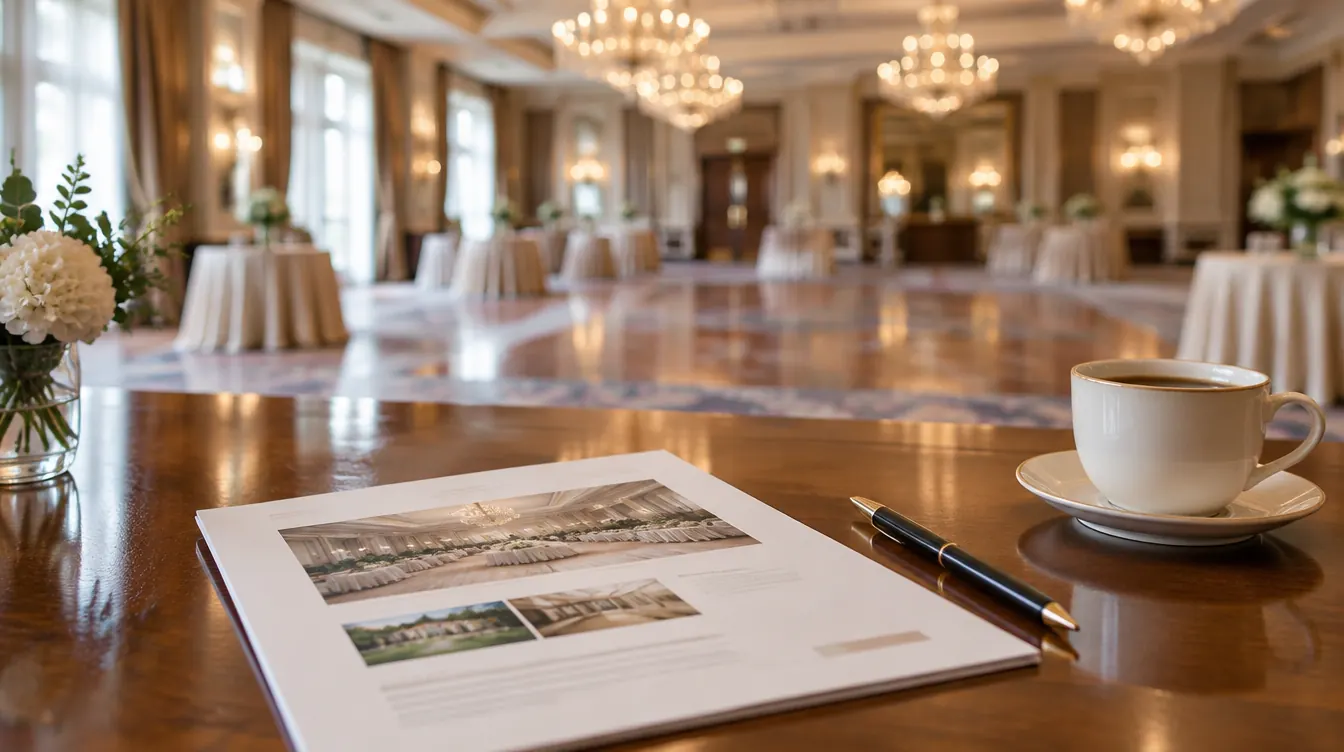
An event proposal that books is short, specific and priced line by line. It tells the client the date, the space, the guest count and exactly what is included, shows how the total is built, and ends with one clear next step and a date the offer is good until. A client who can say yes without sending three follow-up questions is more likely to say yes.
This is general information, not legal advice. Have a lawyer review any wording that could be read as a binding commitment.
What should an event proposal include?
Include everything the client needs to decide, and nothing they will have to wade through. Most proposals need these parts:
- Who it is from and who it is for: your venue's name and contact details, the client's name and how to reach them.
- The event: date, start and end time, the space, and the expected guest count.
- A short introduction: two or three sentences that show you listened. Mention something from the call or the inquiry.
- Itemised pricing: each charge on its own line, with a quantity and a unit price where it applies.
- Service charge and tax, shown as separate lines (more on that below).
- Terms: the deposit that confirms the date, when the balance is due, and when final guest numbers are needed.
- A valid-until date and a way to accept.
Leave out anything that does not change the decision. The full cancellation clause, insurance rules and house policies belong in the contract. The proposal can say "full terms are in the rental agreement" and attach it.
How do I set out the pricing?
Show the total as a sum of lines the client can follow. Group the lines in the order the client thinks about them: the room first, then food and beverage, then extras such as AV or staging.
For per-guest items, show the quantity and the unit price, for example "Dinner service, 120 guests at $85". A client can check that sum against their own guest count and see immediately what changes if the count moves.
Here is the example the event proposal generator opens with. The venue, client and every figure in it are invented placeholders, not recommended prices:
| Line | Qty | Unit | Amount |
|---|---|---|---|
| Room rental, 7 hours | 1 | $5,000 | $5,000 |
| Dinner service, per guest | 120 | $85 | $10,200 |
| Bar package, per guest | 120 | $45 | $5,400 |
| AV and staging | 1 | $850 | $850 |
| Subtotal | $21,450 |
In that example the 20% service charge applies to the dinner and bar lines only ($15,600), so it comes to $3,120. Sales tax of 8% is then charged on the subtotal plus the service charge, which is $1,965.60. The total is $26,535.60. Whether a service charge is taxable depends on the state and on how it is described, so check with your accountant.1 The guide to service charge, gratuity and sales tax explains why the labels matter.
How do I make the offer easy to accept?
End with one next step and a date. "Sign and return this page with the 25% deposit by March 10 and we will hold Saturday, May 14 for you" is a next step. "Let us know if you have questions" is not.
Three details help:
- A valid-until date. It keeps you from holding a date for free, and it gives the client a reason to decide. If you are holding the date while they decide, say so in the introduction.
- A proposal number and issue date. They make it easy to refer back to the right version in an email thread.
- A sign-and-return block. The generator adds one, so the proposal can be emailed, printed or posted. It is a record that the client accepted the quote, not a replacement for your contract.
Sample quote
I put the date I'm holding right at the top of the first page. Clients answer faster when they can see what they could lose.
 Priya RamanCatering & Sales Manager, The Halvorsen Hotel
What mistakes make a proposal harder to say yes to?
Four show up again and again.
- A wall of terms before the price. Lead with the event and the numbers, then the terms.
- Vague lines. "Event package" tells the client nothing. List what is in it, or link to the package description.
- No difference between included and optional. Mark the optional extras clearly so the client can accept the core and add to it.
- A proposal that arrives late. One that lands days after the tour competes with quotes already in the client's inbox. Send it within a day or two.
- Payment terms that differ from the contract. Keep the deposit and balance schedule in the proposal identical to the one in the contract, so nothing changes after the client has agreed.
Use the same words for the same thing every time. If the proposal says "deposit", the contract and the invoice should say "deposit", not "retainer" in one and "booking fee" in another. The deposits and payment schedules guide shows how to set the dates.
How do I send and follow up on a proposal?
Send the proposal as a PDF in a short email, and say in the email what you attached and the date it is valid until. Then follow up once, a few days later, if you have not heard back. Do not chase every day.
The free event proposal generator lets you fill in your details, mark which lines carry the service charge, set the tax, write your terms and download the result as a PDF or Word file. It does not accept payment or signatures online. The document stays in your browser unless you choose to email yourself a link. Online acceptance and e-signature are not part of the free tool. VenueDirector is in early access, and you can join the list on the home page. [REVIEW]
Footnotes
-
New York State Department of Taxation and Finance, Tax Bulletin ST-320, "Gratuities and service charges" (February 23, 2012), https://www.tax.ny.gov/pubs_and_bulls/tg_bulletins/st/gratuities.htm. One state's published guidance, given as an example: treatment differs from state to state. ↩