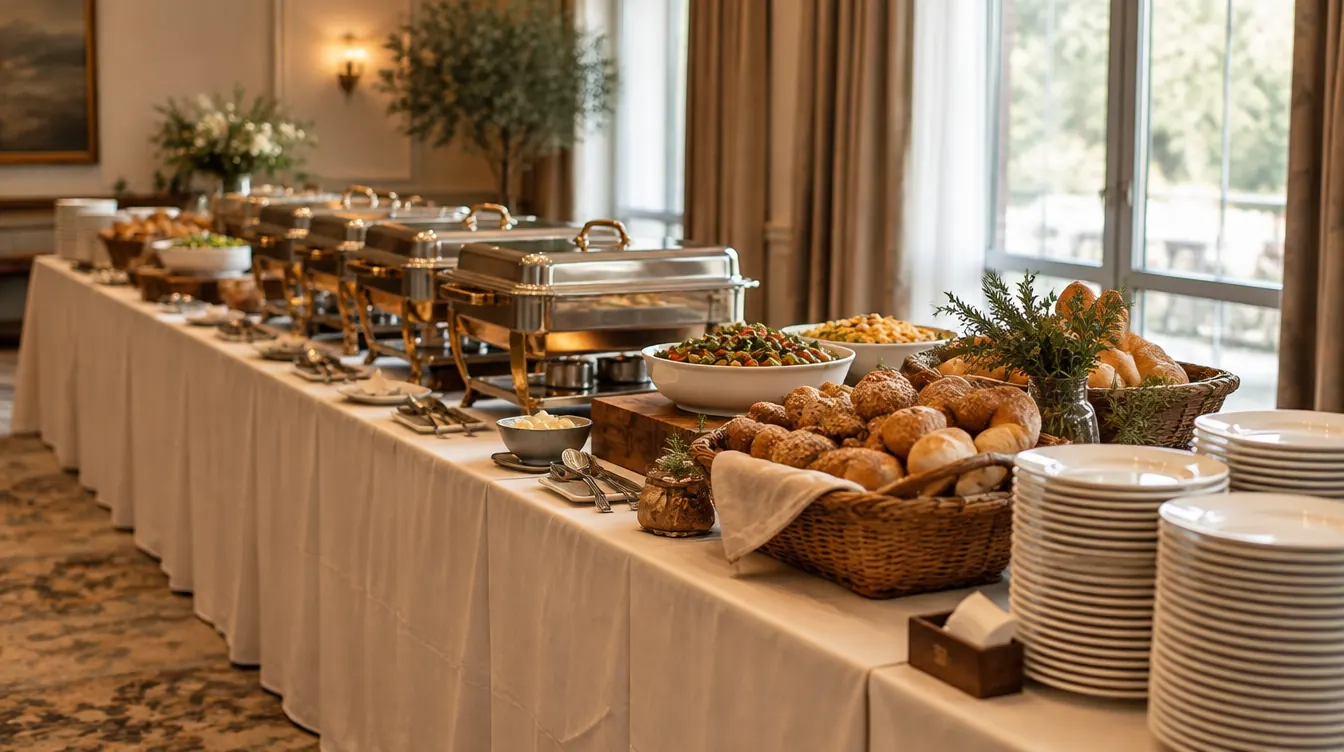
For a seated dinner, plan food by course instead of one pounds-per-person figure: appetizer pieces for the cocktail hour, a cooked portion of protein, sides and salad, bread, and a dessert. As a starting point, a plated dinner for 120 guests might plan 6 appetizer pieces per guest, 6 oz of cooked protein, 8 oz of sides, 3 oz of salad, 1.5 rolls and one dessert. These are planning figures, not an industry standard, and your caterer's numbers should replace them.
How much food per person do I need?
There is no single right amount. It depends on the menu, the service style, the time of day, how long the event runs and who is coming. Any figure you see online is a starting assumption. The useful way to plan is to pick starting amounts for each course, multiply by the guest count, and then compare the result with your caterer's own.
That is how the event catering quantity calculator works. Every per-guest amount on it is editable, and the page says that the caterer will adjust for the actual menu. This article uses its starting amounts for the example below.
If you are cooking for a large group yourself, use tested quantity recipes: University of Minnesota Extension advises using standardized quantity recipes when preparing food for 25 or more people.1
How many appetizers per person?
Multiply the length of the cocktail hour by the pieces per guest per hour, then split the total across your varieties. The calculator starts with 6 pieces per guest per hour when a meal follows, and 10 per hour when appetizers are the whole meal. Both are assumptions to edit.
For 120 guests, a one-hour cocktail hour before dinner, and four varieties:
- 120 guests × 1 hour × 6 pieces = 720 pieces.
- 720 ÷ 4 varieties = 180 pieces of each.
If appetizers are the whole meal, a three-hour reception at 10 pieces per guest per hour gives 120 × 3 × 10 = 3,600 pieces. That is the point where the menu needs to include more substantial items, not only light bites. Ask your caterer what a realistic pace is for the items you choose.
How much main course, sides and salad per person?
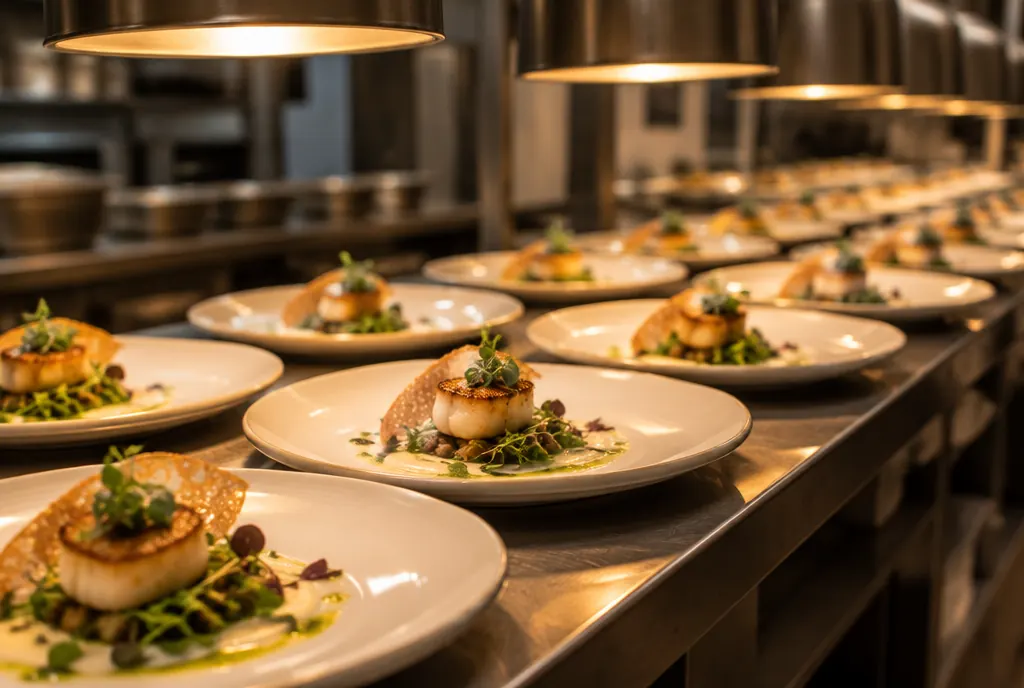
Start from a plated dinner, then scale it for the service style. The calculator's starting amounts, in cooked ounces per guest, are 6 oz of protein, 8 oz of sides and 3 oz of salad, plus 1.5 rolls and one dessert.
For 120 guests at a plated dinner, the totals are:
| Course | Per guest | Total for 120 guests |
|---|---|---|
| Appetizers | 6 pieces | 720 pieces |
| Main protein | 6 oz cooked | 45 lb |
| Sides | 8 oz cooked | 60 lb |
| Salad | 3 oz | 23 lb (rounded up) |
| Bread | 1.5 rolls | 180 rolls |
| Dessert | 1 serving | 120 servings |
The calculator rounds each total up to a whole pound or a whole piece, so you have something you can order. The weights are cooked weights. Vegetarian and other dietary meals are not taken out of these quantities, so plan them with your caterer.
How does service style change the amount?
Buffet and family-style service are usually planned with more food than a plated dinner, because guests choose their own portions and the table has to look full. The calculator scales the main-course amounts by a percentage for each style. Its starting percentages are 120% for a buffet and 125% for family style, and they are editable placeholders.
At 120% for a buffet, the same 120 guests need 7.2 oz of protein each instead of 6, which means 54 lb instead of 45 lb of protein, 72 lb of sides, 27 lb of salad and 216 rolls. At a plated dinner, the kitchen controls the portion. At a buffet, the guests do.
What else changes the quantities?
Several things move the numbers more than the style does:
- The time of day. A lunch needs less than a dinner.
- The length of the event. A long reception needs more, especially with an open bar. The calculator has a late-night snack option, with two pieces per guest as a starting assumption.
- The menu. A heavy main course needs smaller sides. A light one needs more of everything else.
- The guests. A group of teenagers eats differently from a group of retirees. You know your guests better than any calculator does.
- Leftovers. Some venues and caterers have rules about what leaves the building. Ask before you plan to take food home.
How do I use the numbers with a caterer or venue?
Bring them as a starting point. Run the calculator with your guest count and style, then ask the caterer how their portions compare. Differences tell you something: if their protein portion is much smaller or larger than yours, find out why, whether it is the cut, the sides or the plating.
Venues with in-house catering can use the same totals to check a quote. Pair this with your food and beverage minimum and the alcohol guide, since food, drinks and the room fee all draw on the same budget. The event budget guide shows how to split the total.
The calculator keeps your numbers in your browser. It does not know your menu, and it is no substitute for your caterer's own planning. VenueDirector is in early access, and you can join the list on the home page. [REVIEW]
Footnotes
-
University of Minnesota Extension, "Planning the quantity food occasion" (reviewed 2021), https://extension.umn.edu/food/preparing/cooking-at-home/cooking-safely-for-a-crowd/planning-the-quantity-food-occasion. Cited only for the advice to use standardized quantity recipes when preparing food for 25 or more people. It does not give the per-person amounts used above, which are the calculator's editable placeholders. ↩